

How RFID Solves Shopify Inventory Challenges for D2C Brands
Shopify has quickly become the preferred platform for Direct-to-Consumer (D2C) brands. Its flexibility and scalability make it easy for businesses to launch, grow, and sell directly to customers without relying on traditional retail channels.
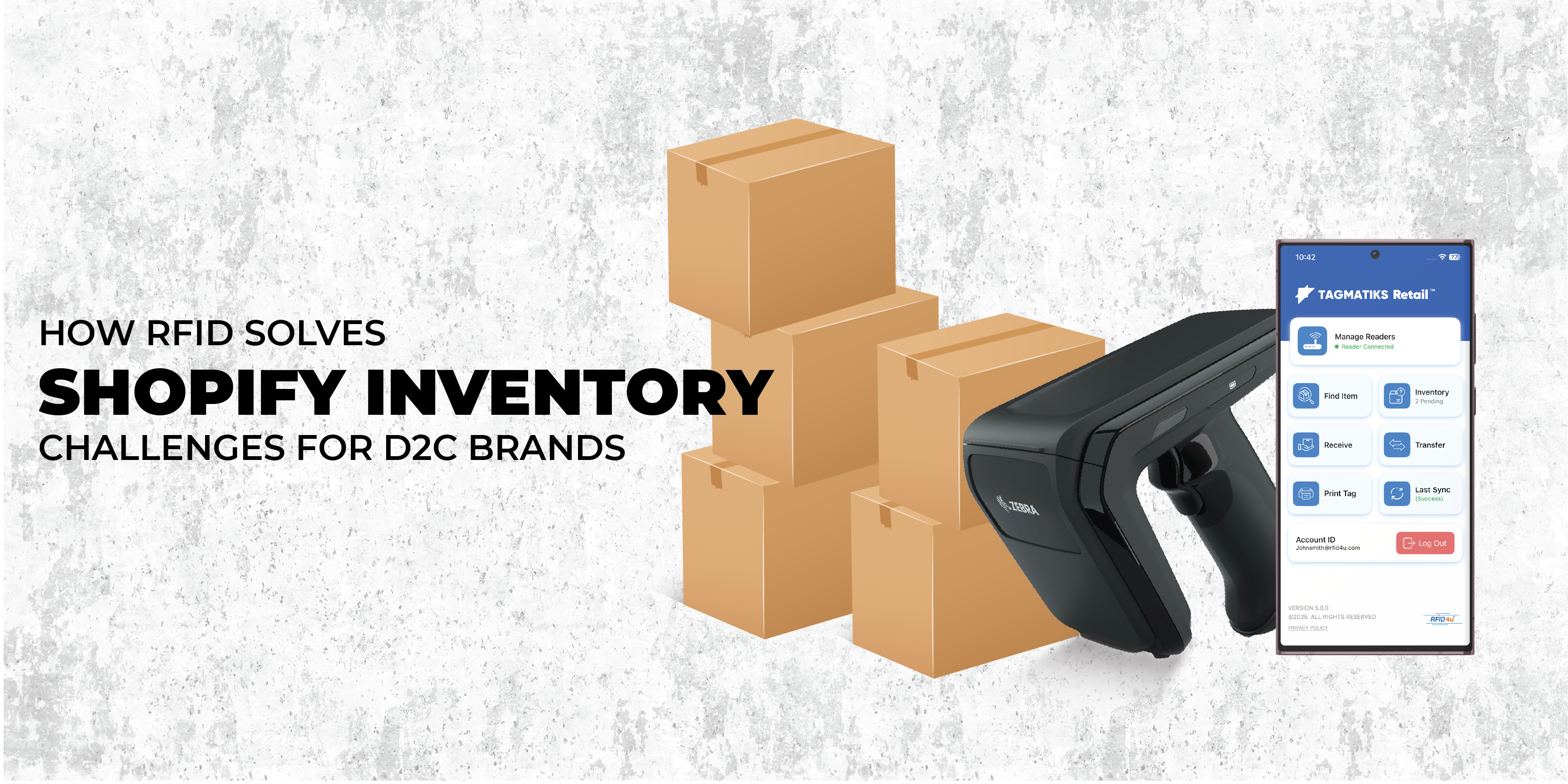
However, as these brands expand, inventory management often becomes a significant challenge. Issues like stockouts, overselling, and manual errors can slow down operations and weaken customer trust.
This is where Radio Frequency Identification (RFID) technology comes in. By automating and streamlining inventory tracking, RFID helps D2C businesses maintain accurate, efficient, and customer-friendly Shopify stores. It’s a game-changer for brands looking to scale smoothly while delivering a seamless shopping experience.
The Inventory Management Struggles of D2C Brands on Shopify
- Stock visibility issues: Many brands struggle to maintain real-time visibility across online stores, warehouses, and pop-up locations.
- Manual inefficiencies: Barcode scanning and manual updates are prone to human error, leading to inaccurate stock counts.
- Customer experience impact: Overselling products or delaying fulfillment damages brand reputation and customer loyalty.
- Scaling challenges: As businesses expand, spreadsheets and manual systems fail to keep up with growing SKUs and sales channels.
What is RFID and How It Works for Shopify D2C Brands
RFID, or Radio Frequency Identification, is a technology that makes tracking inventory faster and more accurate. It uses small tags with microchips that communicate wirelessly with RFID readers.
Here’s how it works in simple terms:
- Tags: Tiny chips attached to products. Each tag carries a unique identifier, like a digital fingerprint for the item.
- Readers: Devices that pick up signals from the tags. Unlike barcodes, they don’t need line-of-sight scanning, which means multiple items can be read at once.
- Software: Connects directly with Shopify, automatically updating inventory levels in real time.
The big advantage over barcodes is speed and accuracy. Instead of scanning items one by one, RFID can capture data instantly, even for large batches of products. For D2C brands handling high volumes of orders, this makes operations smoother, reduces errors, and ensures customers always see the right stock availability on Shopify.
Key Ways RFID Solves Shopify Inventory Challenges for Shopify D2C Brands
RFID technology directly tackles the most common inventory headaches that D2C brands face on Shopify. Automating tracking and syncing data in real time, it helps businesses run more smoothly and scale faster.
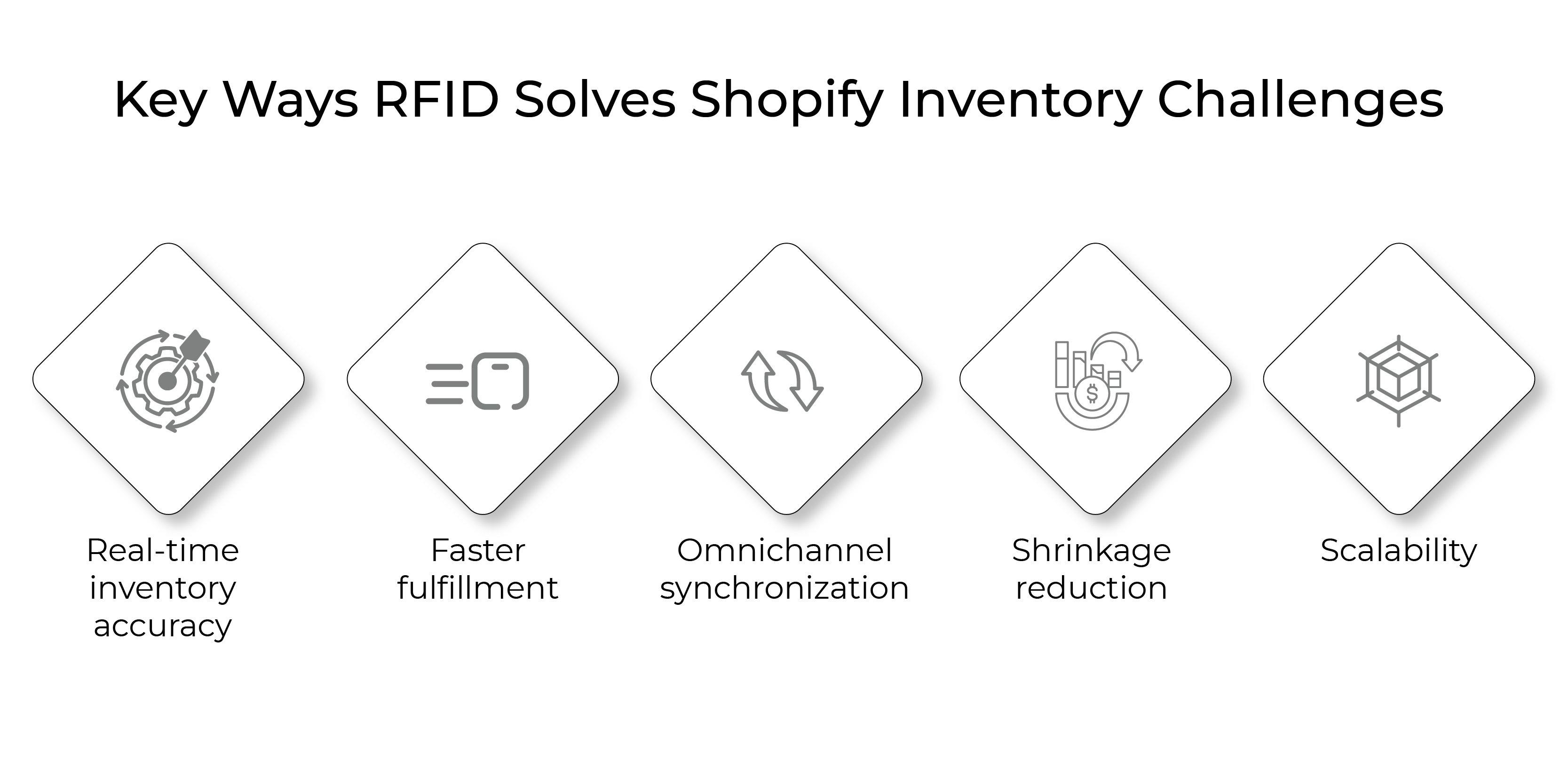
Here are the main ways RFID makes a difference:
Real-time inventory accuracy
RFID ensures that Shopify always shows the correct stock levels. This reduces the risk of overselling and keeps customers confident in product availability.
Faster fulfillment
Staff can quickly locate and pick items without scanning each one manually. This speeds up order processing and improves delivery times.
Omnichannel synchronization
Whether it’s an online store, warehouse, or retail outlet, RFID keeps inventory data unified across all channels.
Shrinkage reduction
By tracking items more effectively, RFID helps reduce losses from theft or misplaced products.
Scalability
Unlike manual systems that break down as a business grows, RFID scales easily with increasing SKUs and sales volume.
Case Scenarios: How D2C Shopify Brands Solve Inventory Challenges with RFID
RFID’s impact spans multiple industries:
- Apparel & Fashion: Prevent overselling during flash sales and streamline returns.
- Footwear: Track SKUs across sizes and styles, reducing mismatched inventory.
- Beauty & Cosmetics: Manage high-volume SKUs, track expiration dates, and ensure bundle accuracy.
- Health & Wellness: Maintain accurate stock for supplements, fitness gear, and personal care items.
- Electronics & Gadgets: Track fast-moving SKUs and reduce shrinkage in fulfillment centers.
- Home & Lifestyle: Manage multi-channel inventory for décor, furniture, and kitchenware.
- Sports & Outdoor Gear: Handle seasonal demand spikes with RFID-enabled warehouses.
- Food & Beverage (packaged goods): Track batch-level inventory and reduce waste.
- Luxury Goods & Accessories: Authenticate items and prevent counterfeit issues.
These scenarios highlight how RFID adapts to different industries, solving unique inventory challenges while enhancing customer trust.
Integrating RFID with Shopify for D2C Brands
One of the biggest advantages of RFID is how smoothly it connects with Shopify. Through apps and APIs, RFID systems can sync product data directly into the Shopify backend, keeping inventory accurate without extra manual work.
Here’s what the integration process usually looks like:
Implementation steps:
- Hardware setup: Attach RFID tags to products and install readers in warehouses or stores.
- Software integration: Connect the RFID system with Shopify so inventory updates happen automatically in real time.
- Staff training: Teach teams how to use RFID readers and software, ensuring a smooth transition.
- Cost considerations: Of course, there are cost considerations. The initial investment in RFID hardware and software can feel significant. But the return on investment comes quickly—brands save time, reduce errors, speed up fulfillment, and improve customer satisfaction. Over time, these benefits outweigh the upfront costs, making RFID a smart choice for growing D2C businesses on Shopify.
Benefits of RFID Beyond Inventory for Shopify D2C Brands
RFID offers more than just accurate stock counts. It creates lasting advantages that improve customer experience, business insights, and overall efficiency.
Enhanced customer experience
Shoppers see real-time product availability, reducing frustration and building trust. Accurate inventory ensures smoother purchases and fewer disappointments.
Data-driven insights
RFID provides visibility into product movement and sales trends, helping brands make smarter decisions about demand, promotions, and future inventory planning.
Operational efficiency
Faster audits, reduced labor costs, and streamlined workflows save time and resources, allowing teams to focus on growth and customer satisfaction.
Future of RFID in D2C Commerce
RFID is quickly becoming more than just an inventory tool—it’s shaping the future of how D2C brands operate. As technology evolves, RFID is turning into the backbone of smart warehouses and AI-driven inventory systems, helping businesses stay ahead of customer expectations.
Conclusion
RFID has proven to be a powerful solution for tackling Shopify inventory challenges. By delivering accuracy, speed, and scalability, it helps D2C brands avoid common pitfalls like overselling and stockouts. More importantly, RFID isn’t just another tool—it’s a competitive advantage. With real-time visibility and smoother operations, brands can build stronger customer trust, scale confidently, and stay ahead in the fast-paced world of D2C commerce.
Recent Posts
-
How RFID Solves Shopify Inventory Challenges for D2C Brands
Shopify has quickly become the preferred platform for Direct-to-Consumer (D2C) brands. Its flexibili …Mar 16th 2026 -
RFID vs Barcode in Retail: A Side-by-Side Comparison
Introduction Retail is transforming at a rapid pace, and at the center of this change lies inventory …Mar 6th 2026 -

What Is an RFID Self-Checkout System? A Complete Guide for Retailers
Introduction Retail checkout has seen a remarkable transformation over the years. What started with …Feb 27th 2026