
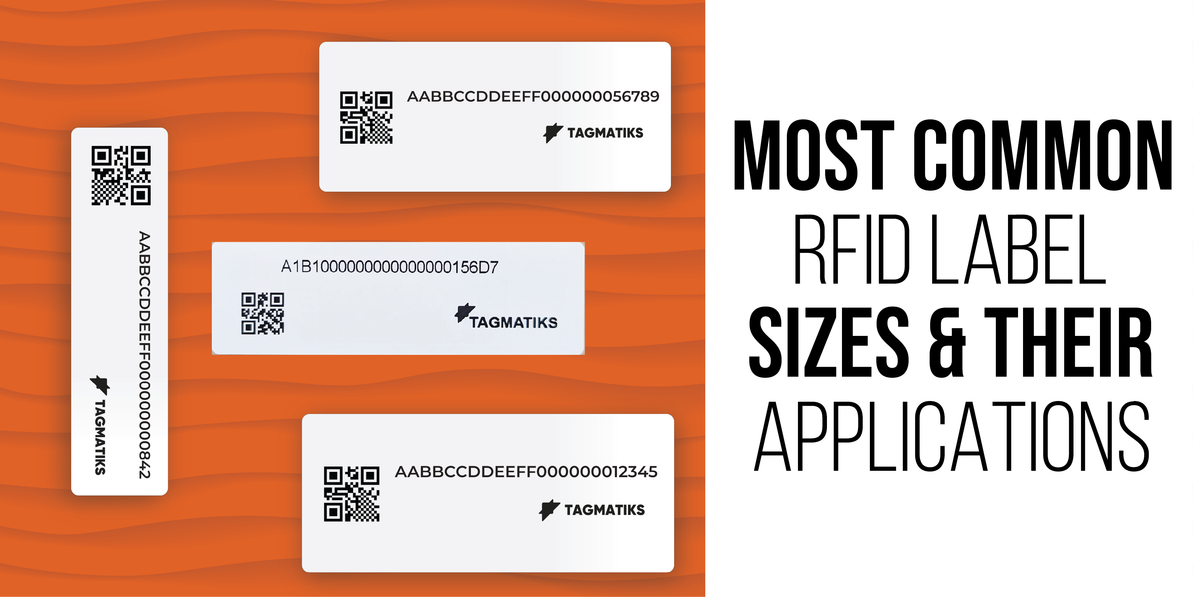
Most Common RFID Label Sizes and Their Applications
Introduction
Radio Frequency Identification has become a cornerstone of modern tracking and inventory management. From retail shelves to industrial warehouses, RFID labels help businesses improve visibility, reduce errors, and streamline operations.
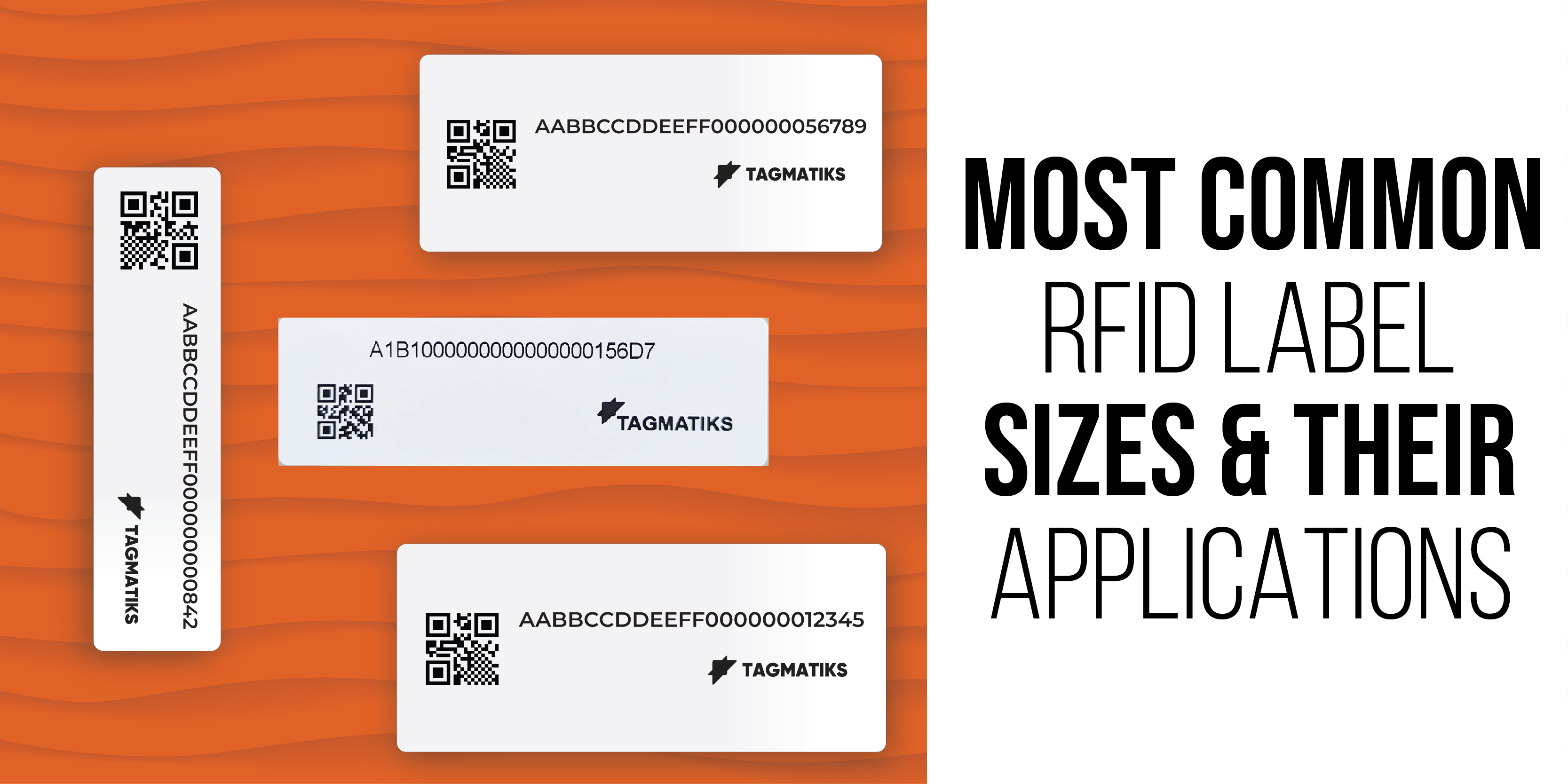
One factor that often gets overlooked is label size. The size of an RFID label directly impacts its performance, cost, and suitability for different applications. Choosing the right size ensures reliable scanning, efficient placement, and cost-effectiveness.
As the saying goes: “From retail shelves to industrial assets, size impacts success.
Why RFID Label Size Matters
- Antenna size and read range: Larger antennas generally provide longer read ranges, while smaller ones are ideal for compact items but may have shorter ranges.
- Durability and flexibility: The physical dimensions of a label affect how well it withstands handling, bending, or environmental stress.
- Placement considerations: Smaller labels fit discreetly on items like jewelry or pharmaceuticals, while larger ones are better suited for pallets or industrial equipment.
- Balancing compactness vs. performance: Businesses must weigh the need for discreet placement against the requirement for strong readability.
Common RFID Label Sizes
Small-Sized RFID Labels for Item-Level Tagging
- 44x18 mm
- Applications: Apparel & retail item-level tagging, pharmaceuticals, healthcare, supply chain logistics.
- Best For: Compact items where space is limited but tracking accuracy is critical.
- 50x25 mm
- Applications: Apparel, retail, healthcare, logistics.
- Best For: Slightly larger items needing balance between readability and discreet placement.
- 54x34 mm
- Applications: Apparel, retail, healthcare, logistics.
- Best For: Broader surface items, offering stronger read range while still compact.
- 74x18 mm
- Applications: Apparel, retail, healthcare, logistics, asset management.
- Best For: Narrow but longer items; useful for asset tagging in addition to retail.
Medium to Large RFID Labels for Case & Pallet Tagging
- 100x150 mm
- Applications: Pallet & case tagging, e-commerce shipping, warehouse bin identification.
- Best For: Large-scale logistics, ensuring visibility and reliable scanning in bulk operations.
- 100x25 mm
- Applications: Case-level tagging, asset management, library & document management.
- Best For: Mid-sized assets, cartons, or document tracking in libraries and archives.
On-Metal RFID Labels for Challenging Environments
Metal surfaces can interfere with RFID signals, so specialized on-metal labels are designed with shielding layers to ensure reliable performance.
- On Metal 70x30 mm
- Applications: IT asset management, industrial assets, hospital equipment.
- Best For: Durable tagging on metallic surfaces in IT and healthcare.
- On Metal 60x25 mm
- Applications: IT asset management, industrial assets, hospital equipment.
- Best For: Slightly smaller footprint for tighter spaces on metal surfaces.
- On Metal 45x18 mm
- Applications: IT asset management, industrial assets, hospital equipment.
- Best For: Compact IT devices or medical instruments requiring precise tracking.
- On Metal 45x08 mm
- Applications: Challenging retail goods, sports equipment, beauty & personal care.
- Best For: Small, irregularly shaped items where traditional labels fail.
- On Metal 60x06 mm
- Applications: Challenging retail goods, sports equipment, beauty & personal care.
- Best For: Ultra-slim design for tagging narrow or curved surfaces.
|
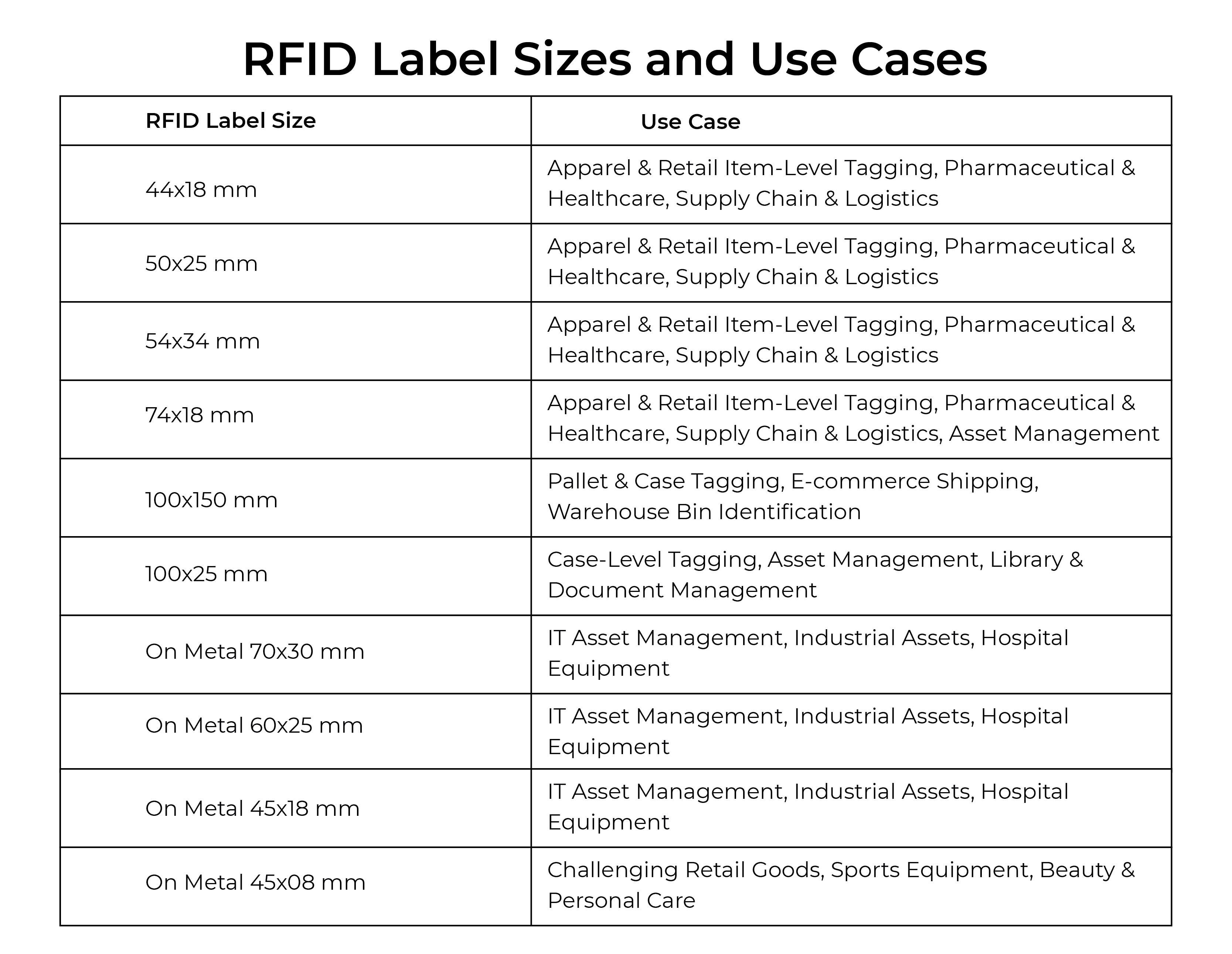
RFID Labels Size (mm) |
Applications |
Best For |
|
Apparel & retail item-level tagging, pharmaceuticals, healthcare, supply chain logistics |
Compact items where space is limited but tracking accuracy is critical |
|
|
Apparel, retail, healthcare, logistics |
Slightly larger items needing balance between readability and discreet placement |
|
|
Apparel, retail, healthcare, logistics |
Broader surface items, offering a stronger read range while still compact |
|
|
Apparel, retail, healthcare, logistics, asset management |
Narrow but longer items; useful for asset tagging in addition to retail |
|
|
Pallet & case tagging, e-commerce shipping, warehouse bin identification |
Large-scale logistics, ensuring visibility and reliable scanning in bulk operations |
|
|
Case-level tagging, asset management, library & document management |
Mid-sized assets, cartons, or document tracking in libraries and archives |
|
|
IT asset management, industrial assets, hospital equipment |
Durable tagging on metallic surfaces in IT and healthcare |
|
|
IT asset management, industrial assets, hospital equipment |
Slightly smaller footprint for tighter spaces on metal surfaces |
|
|
IT asset management, industrial assets, hospital equipment |
Compact IT devices or medical instruments requiring precise tracking |
|
|
Challenging retail goods, sports equipment, beauty & personal care |
Small, irregularly shaped items where traditional labels fail |
|
|
Challenging retail goods, sports equipment, beauty & personal care |
Ultra-slim design for tagging narrow or curved surfaces |
Factors to Consider When Choosing RFID Label Size
Read range requirements
The size of the RFID label directly affects the distance at which it can be read. Larger labels typically offer longer read ranges, making them ideal for use on pallets or in warehouses, while smaller labels are suited for close-range scanning of compact items.
Surface type
Different surfaces impact RFID performance. Labels designed for metal, plastic, fabric, or paper ensure accurate scanning. Choosing the right label for the surface prevents signal interference and improves reliability, especially in industries like healthcare, retail, and manufacturing.
Environmental conditions
RFID labels must withstand the environment in which they operate. Exposure to heat, moisture, or chemicals can affect performance. Durable labels are essential for industrial, healthcare, or outdoor applications where conditions are more demanding, and reliability is critical.
Cost vs. performance trade-offs
Smaller labels may be more affordable but often have limited read ranges. Larger labels deliver stronger performance and visibility but come at a higher cost. Businesses should balance budget with operational needs to ensure efficiency and accuracy.
Conclusion
Choosing the right RFID label size is essential for achieving accurate tracking, efficient operations, and cost-effectiveness. From small item-level tags to large pallet labels and specialized on-metal options, each size serves a unique purpose. The right choice ensures stronger performance, better visibility, and improved supply chain efficiency.
Recent Posts
-
Most Common RFID Label Sizes and Their Applications
Introduction Radio Frequency Identification has become a cornerstone of modern tracking and inventor …Feb 2nd 2026 -

RFID Readers Buying Guide — Everything You Need to Know
Introduction Radio Frequency Identification (RFID) is a technology that uses radio waves to identify …Jan 19th 2026 -

IT Asset Tracking Made Simple with RFID Software Solutions
Introduction to RFID Software for IT Asset Tracking Managing IT assets—servers, laptops, networking …Jan 12th 2026